


When Valve officially revealed the Steam Machine, most of the discussion quickly centered on one topic: its price. Social media filled with comparisons to gaming PCs, debates over its value, and questions about whether gamers would be willing to spend that much on a living room gaming system. While opinions varied, the announcement highlighted a much bigger question than the Steam Machine itself.
For me, the real story isn’t whether Valve priced the system correctly. Instead, it’s what that price reveals about the future of gaming hardware. If building a modern gaming system has become this expensive today, what does that mean for the next generation of consoles from Microsoft and Sony?
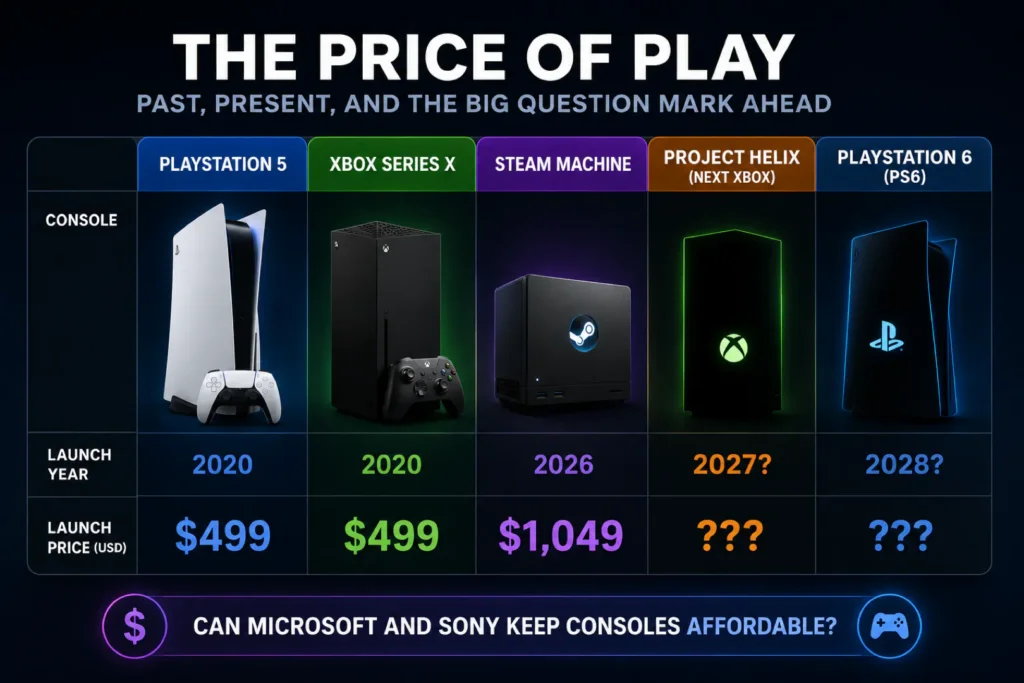
That question feels more important than ever. Rumors continue pointing toward Microsoft’s next-generation XBOX, reportedly known internally as Project Helix, arriving as early as late 2027. Sony is widely expected to follow with the PlayStation 6 sometime in 2028 or later. Although neither company has officially announced its next-generation console, both are already facing the same economic realities affecting the rest of the technology industry.
Unlike previous generations, the biggest challenge may not be creating more powerful hardware. It may be building that hardware at a price millions of players can actually afford. Consoles have always represented gaming’s most accessible entry point, offering powerful experiences without the complexity or cost of a high-end gaming PC. That identity could soon be tested in ways we’ve never seen before.
The Steam Machine Is a Symptom, Not the Problem

It would be easy to blame Valve for introducing an expensive piece of hardware. After all, the Steam Machine’s price immediately drew comparisons to the PlayStation 5 Pro, XBOX Series X, and even entry-level gaming PCs. For many players, it felt like another sign that gaming continues becoming more expensive every year.
I don’t believe Valve is the problem. In fact, the company has been transparent about what the Steam Machine is designed to be. Rather than competing directly with traditional consoles, it offers a PC-based experience centered around SteamOS and the existing Steam ecosystem. When compared with gaming PCs offering similar specifications, the pricing becomes easier to understand, even if it remains out of reach for many consumers.
What makes the announcement significant is that it provides a glimpse into the current cost of building modern gaming hardware. Valve isn’t subsidizing the Steam Machine in the same way Microsoft and Sony have traditionally subsidized their consoles. Instead, its pricing reflects a product built much closer to its actual manufacturing cost.
That distinction matters because Microsoft and Sony will eventually have to build entirely new systems using many of the same technologies. Faster processors, more advanced graphics chips, larger amounts of memory, and faster storage will all be required to move the industry forward. If those components continue becoming more expensive, the next XBOX and PlayStation may face pricing challenges unlike any previous console generation.
Hardware Is Becoming More Expensive for Everyone

The rising cost of gaming hardware isn’t happening because one company decided to charge more. It reflects broader changes across the entire technology industry. Nearly every manufacturer that depends on advanced processors, memory, or storage is competing for the same limited resources.
Artificial intelligence has become one of the biggest drivers of those rising costs. Companies building massive AI data centers require enormous amounts of DRAM memory, NAND storage, and advanced silicon. That demand extends far beyond gaming and has reshaped the global supply chain for many of the components that also power consoles, graphics cards, and gaming PCs.
Microsoft recently acknowledged those challenges while discussing the company’s latest hardware price increases. The company stated, “Unfortunately, console storage and memory prices have increased by more than 2.5x and we expect another doubling by the fall of 2027.” That statement alone should make every console player pay attention. It suggests Microsoft believes component costs may continue climbing throughout the same period many expect the next XBOX to launch.
Those concerns are shared across the semiconductor industry. Micron CEO Sanjay Mehrotra has said the AI-driven shortage affecting DRAM and NAND memory is expected to continue through 2027 before gradually improving the following year. In other words, the companies building tomorrow’s consoles may be designing them during one of the most expensive periods for memory in recent history.
Consoles Were Never Meant to Be Luxury Products
One of the biggest reasons consoles have remained popular for decades is their simplicity. You buy a single box, connect it to your television, sign in, and start playing. There’s no need to compare graphics cards, check hardware compatibility, or spend hours adjusting graphics settings to find the right balance between image quality and performance. For many players, that plug-and-play experience is just as important as the games themselves.
Consoles have also traditionally been the most affordable way to enjoy new releases. A gaming PC may offer greater flexibility, but it usually comes with a much higher upfront investment. Consoles removed that barrier by delivering modern gaming experiences at a price families could realistically afford. That accessibility helped introduce millions of players to gaming and allowed each new generation to grow beyond the last.
If the next XBOX or PlayStation begins approaching the cost of a high-end gaming PC, that identity starts to change. A console can still offer convenience, but it becomes much harder to market it as the affordable option. Families looking to buy a new system may decide to keep their current console longer, wait for discounts, or skip the generation altogether. Those decisions could affect software sales just as much as hardware sales.
Microsoft and Sony understand this better than anyone. Their goal has never been to sell the most expensive gaming hardware possible. Their business depends on building an audience that buys games, subscribes to online services, and remains invested in the platform for years. A console that fewer people can afford creates challenges long after launch day.
Microsoft Is Already Acknowledging the Challenge
Recent comments from Microsoft suggest the company is thinking about this issue long before its next console arrives. Speaking to Fortune, XBOX executive Asha Sharma discussed the growing cost of hardware and the impact AI is having across the technology industry. Rather than focusing only on manufacturing expenses, she raised a broader concern about affordability.
According to Sharma, the industry has “reached a point where it will be hard to imagine” mass audiences being able to afford “thousands of dollars” for a new generation of gaming hardware. Coming from one of the executives helping shape Microsoft’s gaming strategy, those comments carry far more weight than speculation from analysts or social media.
It’s also worth noting what Sharma didn’t say. She didn’t suggest that players should simply accept higher prices, nor did she argue that premium hardware is the inevitable future of gaming. Instead, her comments acknowledge the difficult balance facing every platform holder. Players expect more powerful hardware with every generation, but those expectations collide with rising development costs and increasingly expensive components.
That balance may become the defining challenge of the next generation. Microsoft has already raised prices on XBOX consoles, accessories, and Game Pass over the past few years. Each increase can be explained individually, yet together they show how much the economics of gaming have changed since the XBOX Series X and PlayStation 5 launched in 2020.

Should Microsoft and Sony Wait?
This raises an interesting question that doesn’t receive enough attention. If memory prices are expected to remain elevated through 2027 before improving gradually in 2028, would delaying the next generation actually benefit Microsoft and Sony?
At first, the idea seems reasonable. Waiting an additional year could reduce manufacturing costs, improve component availability, and allow companies to deliver stronger hardware without increasing retail prices as dramatically. Consumers would likely welcome a more affordable console, especially if it launches with better technology than originally planned.
The problem is that console launches are about much more than hardware costs. Developers need a clear roadmap for future games, publishers want new hardware to help drive software sales, and platform holders must remain competitive with one another. If Microsoft delays while Sony moves forward, or vice versa, one company could gain an important advantage during the early years of the next generation.
There is also the question of the current hardware. By late 2027, the XBOX Series X and PlayStation 5 will be approaching seven years on the market. While both systems continue delivering excellent games, developers are already making compromises to support increasingly ambitious projects. Extending their lifespan even further may save money in the short term, but it could also slow innovation at a time when players are eager to see what the next generation can deliver.
For that reason, I don’t believe delaying is the most likely outcome. Instead, Microsoft and Sony may need to rethink what a next-generation console looks like. Rather than chasing the largest performance jump possible, they may focus on delivering meaningful improvements while keeping prices within reach of the average player.
The Next Generation Doesn’t Have to Follow the Same Formula
If rising hardware costs continue, Microsoft and Sony have more choices than simply increasing prices. The next generation doesn’t have to follow the same strategy that defined previous console launches. In fact, recent years suggest both companies have already started experimenting with different approaches.
One possibility is expanding the number of hardware options available at launch. Instead of offering a single console, each company could introduce an entry-level digital model alongside a more powerful premium version. That strategy allows players to choose the experience that best fits their budget while giving manufacturers more flexibility in how they price their hardware.
We’ve already seen the foundation for this approach. Microsoft launched the XBOX Series S alongside the Series X, while Sony introduced both disc and digital versions of the PlayStation 5. More recently, the PlayStation 5 Pro demonstrated that a significant number of players are willing to spend more for higher-end hardware. Building on that strategy could make even more sense if manufacturing costs continue rising over the next several years.
There is also another path that may prove just as important: focusing on efficiency instead of raw performance.
Smarter Hardware May Matter More Than Bigger Hardware
For years, every console generation was measured by how much more powerful it was than the one before. Higher resolutions, larger worlds, and more realistic graphics became the primary selling points. While those improvements remain important, they also become increasingly expensive to achieve with each new generation.
Recent advances in rendering technology suggest there may be another way forward. AI-assisted upscaling, frame generation, and smarter rendering techniques allow developers to produce impressive visuals without relying entirely on brute-force hardware. Rather than rendering every frame natively at 4K, games can reconstruct high-quality images while reducing the workload placed on the GPU.
Players have already benefited from these technologies on both consoles and PCs. The average player often notices smoother gameplay and better image quality without necessarily knowing how those results were achieved. If those technologies continue improving, Microsoft and Sony may be able to deliver noticeable visual gains without dramatically increasing the size, power consumption, or cost of their hardware.
That shift could benefit developers as well. Instead of spending enormous budgets chasing diminishing graphical improvements, studios could invest more resources into gameplay systems, storytelling, world design, and polish. Better technology should make creating great games easier, not simply make creating expensive games possible.
Maybe the Industry Is Chasing the Wrong Goal
This discussion also connects to a broader trend we’ve talked about before on GameTechXd. The industry has become increasingly focused on producing larger, longer, and more visually realistic games. While those experiences can be incredible, they also require larger teams, longer development cycles, and significantly higher budgets.
We’ve reached a point where some of the biggest games take six, eight, or even ten years to develop. During that time, studios grow larger, production costs continue climbing, and publishers face increasing pressure for each release to become a massive commercial success. If a single game underperforms, the consequences can include layoffs, restructuring, or even studio closures.
At the same time, many of the most memorable games released in recent years haven’t relied solely on cutting-edge graphics. Titles like Hades, Astro Bot, Balatro, and Clair Obscur: Expedition 33 have earned widespread praise because of their gameplay, artistic direction, and memorable experiences. They remind us that players rarely remember how many pixels a game rendered. They remember how a game made them feel.
That doesn’t mean graphics no longer matter. Visual presentation remains an important part of modern game design. However, there comes a point where each additional graphical improvement costs exponentially more while delivering smaller gains that many players barely notice during normal gameplay.
If the next XBOX and PlayStation can strike a better balance between visual fidelity, development costs, and affordability, the entire industry could benefit. Publishers would face less financial pressure, developers could ship games more frequently, and players would continue receiving great experiences without paying dramatically more for new hardware.
My Prediction for Project Helix and PlayStation 6
Based on everything we’ve seen over the past few years, I don’t believe Microsoft or Sony wants to launch an $800 standard console. Both companies understand that consoles succeed because they remain accessible to millions of players. Pricing too aggressively risks slowing adoption, reducing software sales, and weakening the long-term health of each platform.
At the same time, I also find it increasingly difficult to believe the next generation will begin at the $499 price point that defined previous launches. Microsoft’s own comments about memory costs, combined with the semiconductor industry’s outlook through 2027, suggest the financial pressures facing hardware manufacturers are unlikely to disappear anytime soon.
If Project Helix launches toward the end of 2027, as many rumors suggest, I believe Microsoft will do everything possible to keep its primary console below the psychological barrier of $700. My expectation is that the standard model could launch between $599 and $699, with a premium version potentially reaching $899 if Microsoft chooses to offer multiple configurations.
Sony may find itself in a similar position if the PlayStation 6 arrives in 2028. By then, memory prices may begin stabilizing, but that doesn’t necessarily mean every other component becomes less expensive. A modest improvement in manufacturing costs could help Sony avoid another major price jump, yet I still expect the company to target a launch price that reflects the realities of today’s hardware market rather than those of a decade ago.
Of course, these are only predictions based on the information available today. New manufacturing technologies, changing market conditions, or unexpected economic shifts could alter those plans before either company officially unveils its next console. Even so, the direction of the industry suggests one thing with increasing certainty: the era of expecting dramatically more powerful consoles at the same price may be coming to an end.

Final Thoughts
The Steam Machine didn’t make me worry about Valve’s future. It made me think about the future of console gaming.
For decades, Microsoft, Sony, and Nintendo have offered something that gaming PCs never truly could: a relatively affordable way to experience the latest games. You purchased a console, connected it to your television, downloaded your favorite games, and started playing. That simplicity has helped consoles become the preferred platform for millions of players around the world.
Today, that model is under pressure from forces that extend far beyond gaming. Artificial intelligence has created unprecedented demand for memory and storage. Manufacturing advanced chips continues becoming more expensive, while game development costs keep climbing. Those challenges affect every company building gaming hardware, whether it’s Valve, Microsoft, Sony, or Nintendo.
The Steam Machine’s price may simply be the first clear indication of where those costs are heading. Microsoft’s own warning that console storage and memory prices have already increased more than 2.5 times—and could double again by the fall of 2027—shows that this isn’t speculation. When companies responsible for building gaming hardware acknowledge these pressures publicly, it’s clear the industry is entering unfamiliar territory.
That doesn’t mean the next XBOX or PlayStation is destined to cost $1,000. Both companies understand that consoles succeed because they remain accessible to a broad audience. Pricing too high would slow adoption, reduce software sales, and weaken the ecosystems they have spent decades building. If anything, I believe Microsoft and Sony will work harder than ever to avoid crossing that line, even if it means making difficult compromises in hardware design or offering multiple models at launch.
The bigger question is whether the industry should continue chasing the same goals. Every generation promises larger worlds, more realistic graphics, and increasingly powerful hardware. Those advances are exciting, but they also come with longer development cycles, higher budgets, and more expensive consoles. At some point, the pursuit of technical progress has to be balanced against affordability and accessibility.
Perhaps the next generation shouldn’t be defined by who builds the most powerful console. Instead, it should be defined by who builds the smartest one. A console that delivers meaningful improvements, embraces technologies like AI-assisted rendering, remains easy to use, and most importantly, stays within reach of the average player. That would preserve the role consoles have played for decades: the simplest way for millions of players to experience modern games.
As we look toward Project Helix and the PlayStation 6, I don’t think the biggest question is how many teraflops they’ll have or whether they’ll support even more advanced graphics technologies. The question that matters most is much simpler.
Can Microsoft and Sony keep consoles affordable in a world where the hardware inside them is becoming more expensive every year?
The answer to that question may define the next generation of gaming more than any launch title ever could.
Comments
Join the discussion, but remember always respect eveyone opinion.